


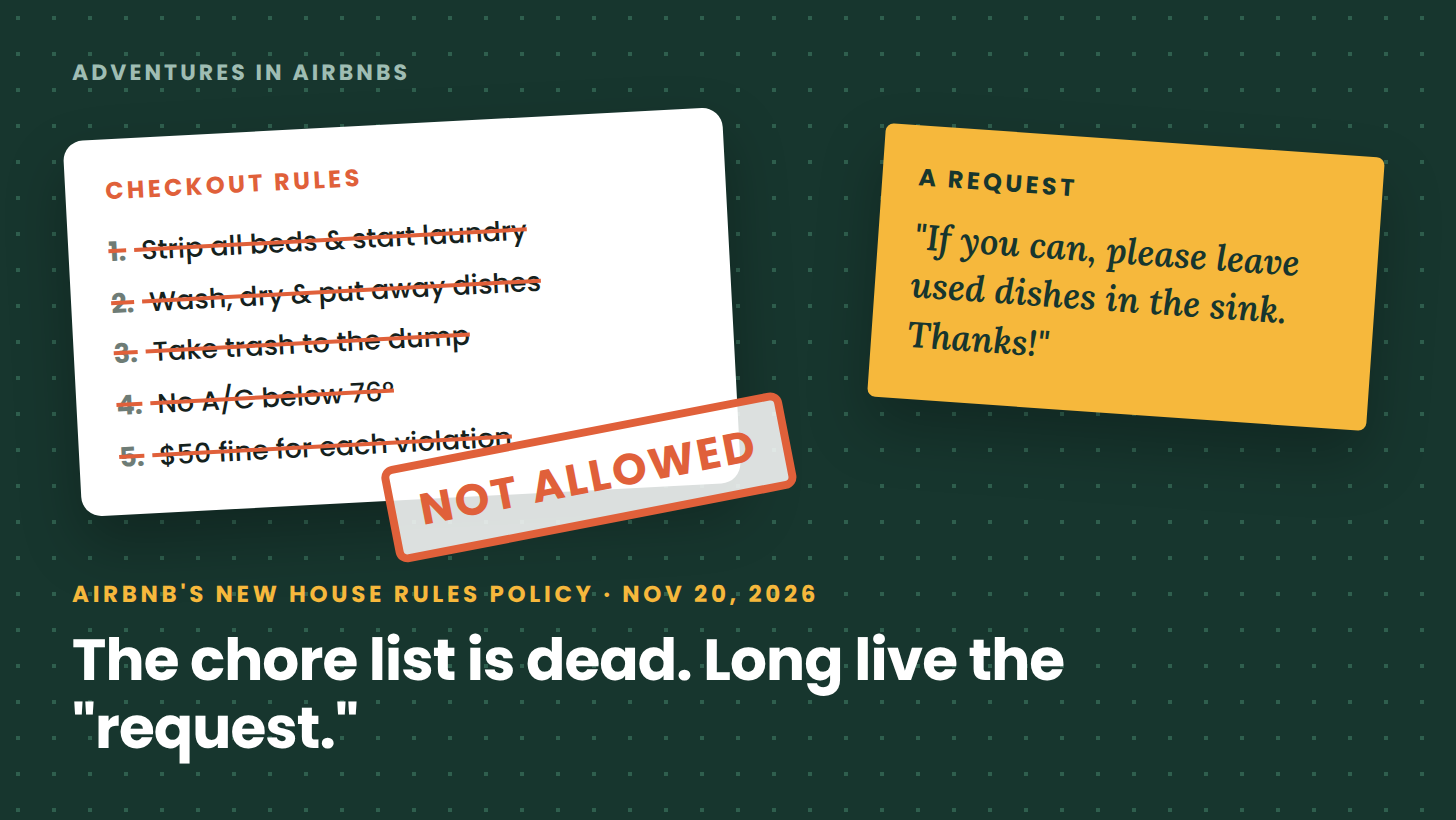
Airbnb just rebuilt house rules. Hosts now pick from 7 standard rules, and everything else becomes a “request” that has to be reasonable. Checkout chores, fines, most contracts and ID collection are out for stays booked on or after November 20, 2026. Below: what changed, what you can still ask for, and a to-do list to fix your listing before the deadline.
We’ve all seen them. The house manuals that read like a lease. The checkout lists that ask guests to strip the beds, start the laundry, run the dishwasher, unload the dishwasher, wipe the counters, take the trash to the curb (or the dump), and text a photo of the thermostat on the way out. And then the fine print: a fee for late checkout, a fine for a forgotten towel, a “penalty” for using the A/C.
Some hosts took it to an art form. Back in 2022, a TikTok of one host’s checkout list, with trash, linens, dishes and laundry, went viral with the caption “$700 for two nights ≠ no chores!” and drew nearly 5,000 comments. In December 2025, a four-page checkout checklist made the rounds on Reddit. And Rental Scale-Up’s editor described a European countryside host who asked her to drive the sorted trash to a collection point. On vacation.
Guests have been grumbling about this for years, usually right after paying a cleaning fee. Airbnb CEO Brian Chesky admitted back in 2022 that “checkout tasks are a pain” and said he’d “heard you loud and clear,” as Rental Scale-Up recounts.
Now Airbnb is doing something about it. On October 20, 2026, it rolled out a new house rules editor and a new policy. The short version: a handful of things are still rules. Anything non-standard is now a “request.” And requests have to be reasonable.
Airbnb’s own explanation, via Euronews: house rules “can be confusing, onerous and hard to manage.” Fair.
The new setup: 7 rules, and everything else is a request
According to Airbnb’s announcement, hosts now choose from seven standard house rules, all set in one place in the Listing editor.
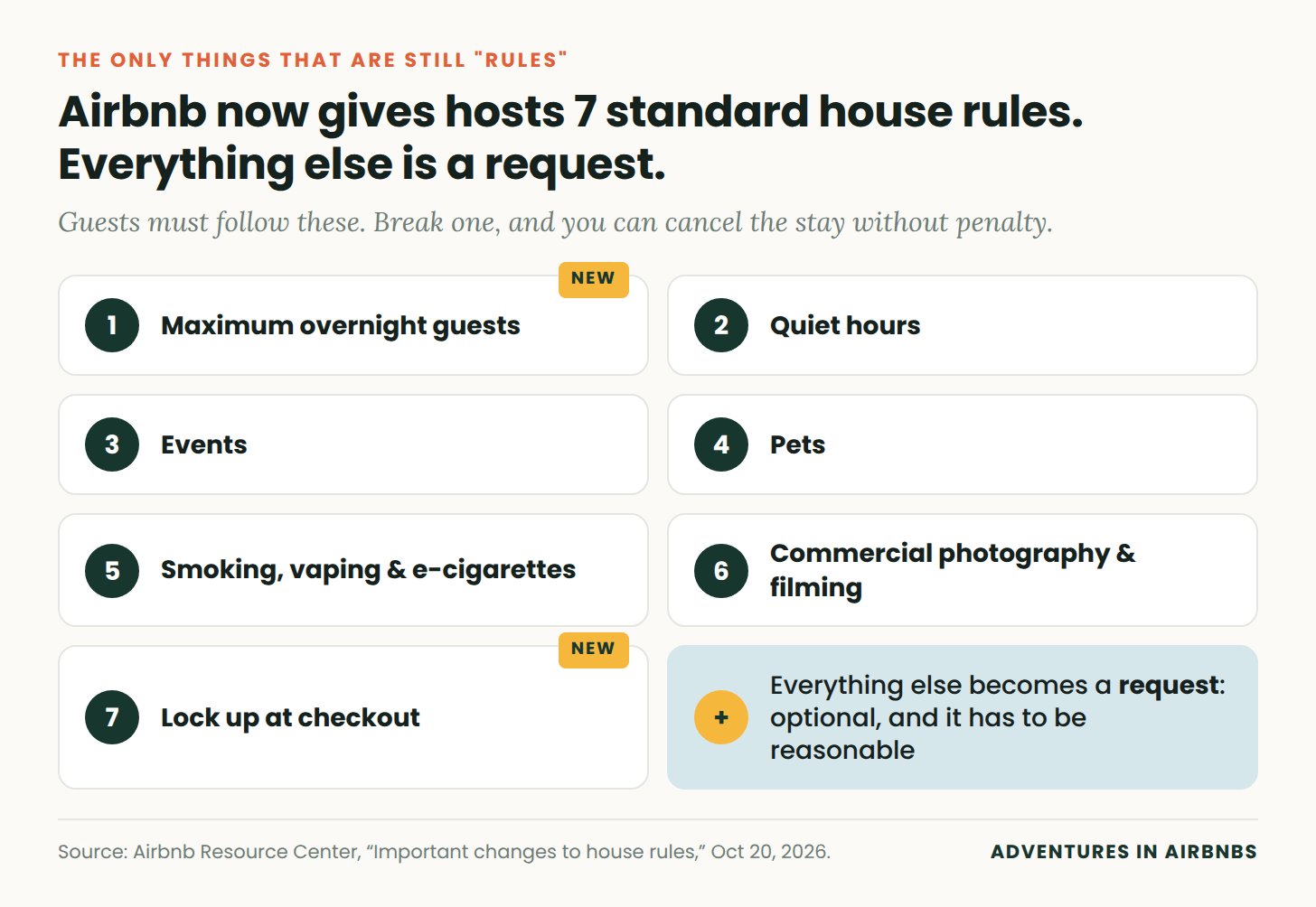
Maximum overnight guests (new)
Quiet hours
Events
Pets
Smoking, including vaping and e-cigarettes
Commercial photography and filming
Lock up at checkout (new)
Anything beyond those goes under a new Requests heading. Airbnb says all requests “must be reasonable,” and what counts as reasonable depends on “the type of listing or stay and relevant local factors.” Airbnb also says it “may grant exceptions based on your situation.”
Why the difference matters
A rule has teeth. A request is a polite ask. Guests “must follow house rules and are encouraged to follow requests,” as Rental Scale-Up puts it. If a guest breaks a house rule, you can cancel the reservation without fees or other consequences. If they ignore a request, you can’t.
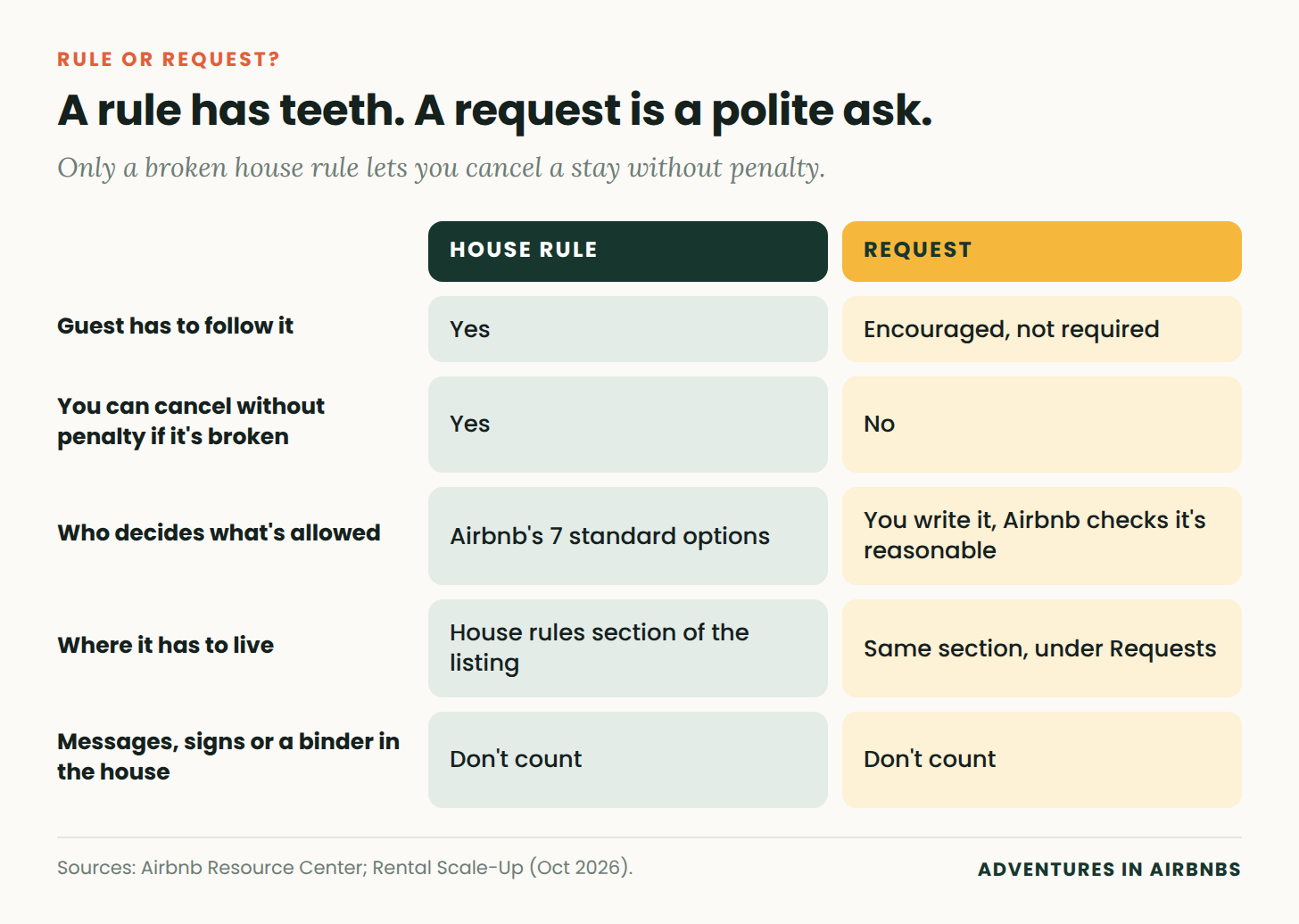
One more catch: your rules and requests have to live in the House rules and requests section of your listing. Airbnb says hosts shouldn’t write extra rules elsewhere on the listing, in messages, or on signs in the home. That laminated sign by the front door with 14 bullet points? It doesn’t count anymore. (You can still send your house rules to a guest as a quick reply in messages.)
Checkout chores: tidy up, yes. Do the cleaner’s job, no.
This is the headline change. Guests can’t be asked to do tasks that take “significant effort or time, or would typically be performed by a cleaner,” per Euronews. Airbnb’s own examples draw the line pretty clearly:
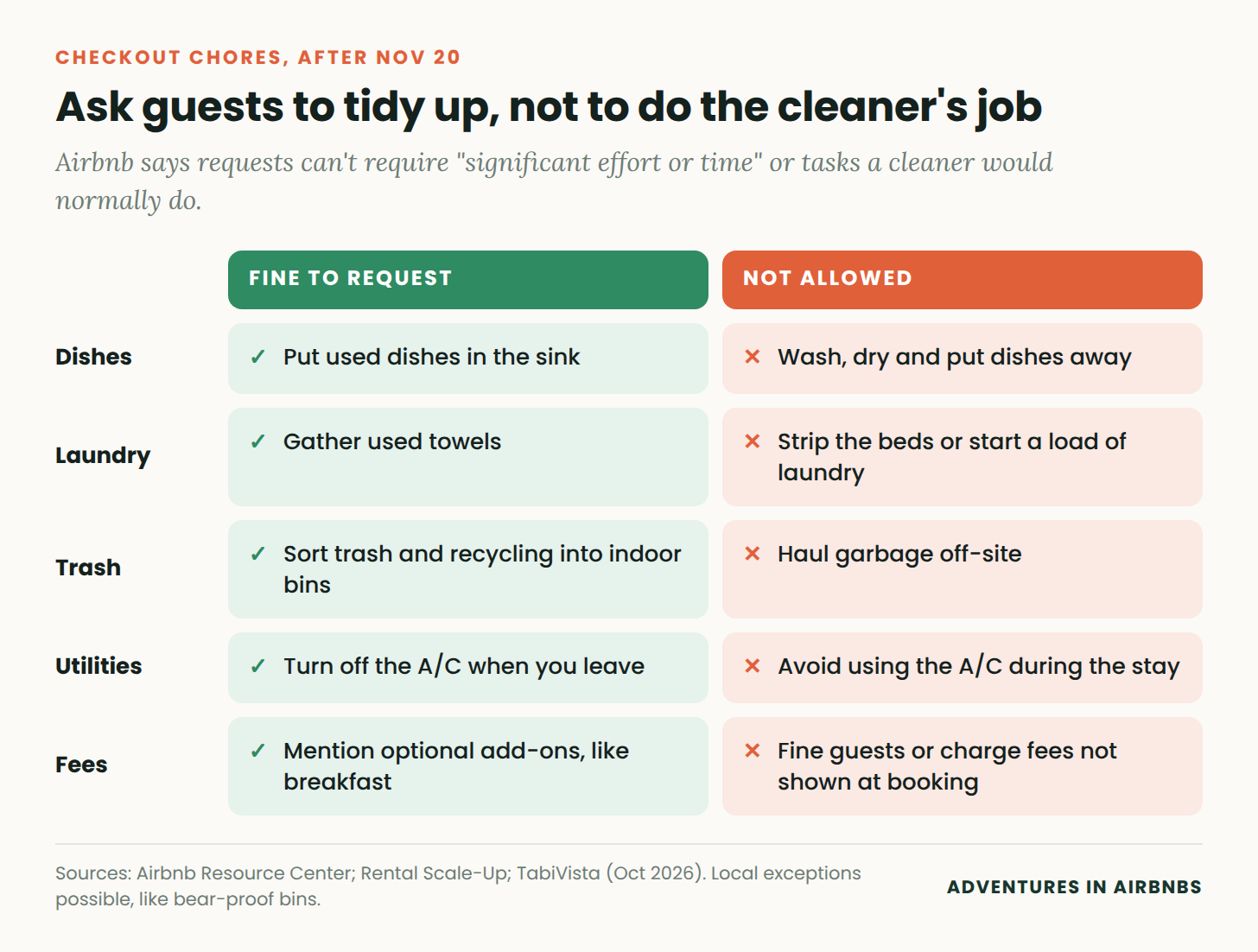
Dishes: You can ask guests to put used dishes in the sink. You can’t ask them to wash and put them away.
Laundry: You can ask them to gather used towels. You can’t ask them to strip the beds or start a load of laundry.
Trash: You can ask them to sort trash and recycling into indoor bins. You can’t ask them to take garbage off-site.
Utilities: You can ask them to turn off the A/C when they leave. You can’t ask them to avoid using an advertised amenity like the A/C during the stay.
There’s room for local common sense. Airbnb says asking guests to use animal-proof trash containers in bear country may be reasonable, and Rental Scale-Up mentions shower limits during a drought as another possible exception. Airbnb hasn’t said whether a lack of local trash pickup would qualify, so if you’re in a rural spot with no curbside service, keep an eye on that one.
And the cleaning fee? Airbnb’s ground rules for guests say cleaning fees “are only meant to cover the cost of standard cleaning between reservations,” and hosts can’t charge extra because a guest skipped a specific checkout task. You can still request reimbursement for real damage, missing items or truly unexpected cleaning.
“You have 30 days to fix either the checkout list or the fee.”
Basit Ali, Hostomat, via Rental Scale-Up
No more fines
This is the part that will sting for a few hosts. According to TabiVista’s summary of the new Help Center rules, “Hosts may not impose fines or other penalties on guests.”
That means goodbye to the kind of $50 late-checkout fine, the $25 “forgot to start the dishwasher” fee, and the “$100 per extra guest found on camera” warning. A few related rules:
Fees for anything advertised must be in the price at booking. No surprise charges for using the hot tub you put in your photos.
Optional add-ons are fine. You can mention something like breakfast or early check-in as an optional request.
HOA and city fines can be mentioned. If your HOA fines owners for parking on the street, you can give guests notice of that.
Airbnb handles the bad actors. Guests who break Airbnb’s policies can face warnings, suspension or removal, and you can still cancel if they break a house rule.
The paperwork crackdown: contracts, ID, apps and reviews
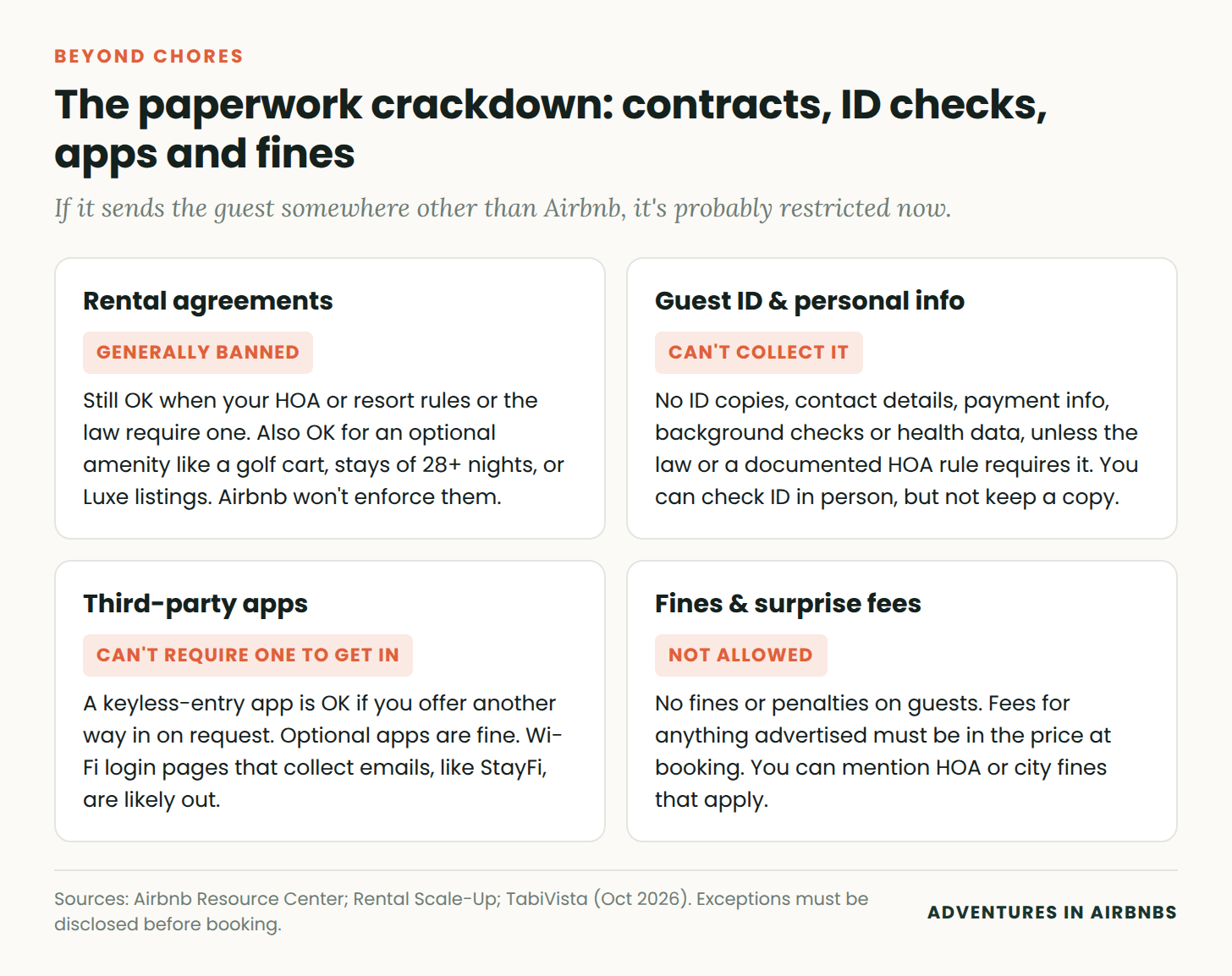
The new policy goes well beyond dishes. If something sends your guest off Airbnb to sign, register or upload, it’s probably restricted now.
Rental agreements
Contracts are “only allowed for a few reasons.” The good news: if your HOA or resort requires a signed agreement, you’re still OK. Airbnb lists homeowners and community association rules as an exception, along with legal requirements, rental agreements for monthly stays (28+ nights), Airbnb Luxe listings, and coverage for optional amenities like golf carts. Keep a copy of the HOA or resort rule that requires it, in case your listing gets flagged. Permitted contracts go in a Contracts section on the listing, where they’re publicly visible. And Airbnb says it “doesn’t help enforce, or require guests to sign, your contracts.”
Guest ID and personal info
By default, hosts can’t collect contact details, ID documents, payment info, background or credit checks, or biometric or health data. The exceptions are when the law or a documented HOA rule requires it, and they have to be disclosed before booking. You can still check ID in person at check-in if you disclose it, but you can’t keep a copy.
Third-party apps and Wi-Fi
You can’t require guests to download an app or register on another website to get into the home or use a critical amenity. A keyless-entry app is OK, as long as you offer another way in on request. Optional apps for speakers or thermostats are fine.
Then there’s Wi-Fi. Airbnb’s new policy bars Wi-Fi login pages that collect email or personal information, except at hotels and resorts. That’s exactly how tools like StayFi work: the guest connects to Wi-Fi through a branded login page that collects names, emails and phone numbers, which hosts then use to market direct bookings. Based on the legalese, StayFi-style email capture is probably out too for regular vacation rentals. If you use it, expect a flag, and plan to switch to an open Wi-Fi network.
Reviews and surveys
Unless you’re a hotel, you can’t ask guests to leave a review or fill out a survey on another website.
Key dates, and what happens if you ignore it
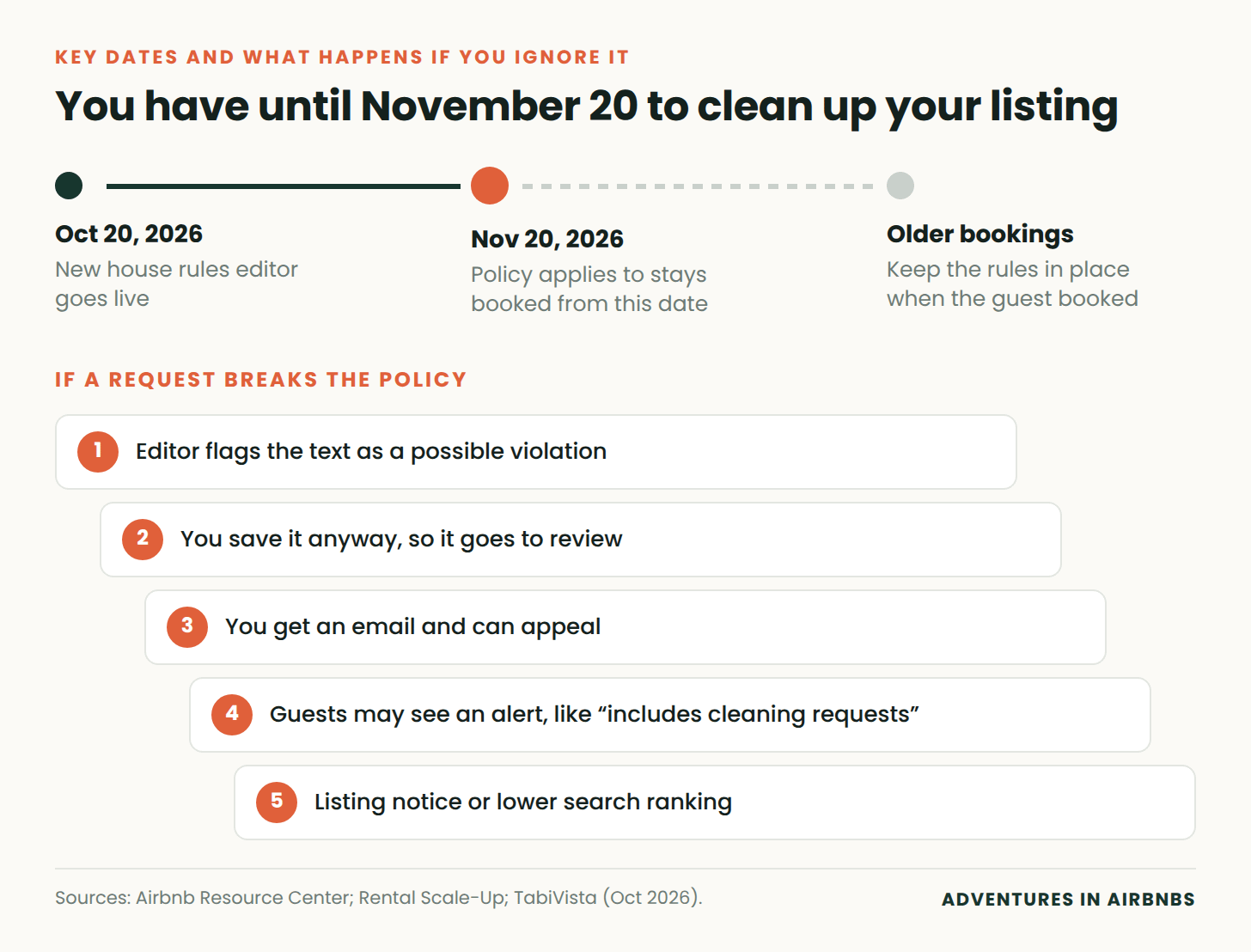
October 20, 2026: The new house rules editor went live.
November 20, 2026: The new policy applies to reservations booked on or after this date. It’s the booking date that counts, not the stay date.
Existing bookings keep the rules that were on the listing when the guest booked.
If you leave a non-compliant request in place, Airbnb escalates in steps:
The Listing editor flags the text as a possible violation.
If you save it anyway, it goes to review.
You get an email, some tips, and a chance to appeal.
If it’s still unresolved, guests may see an alert on your listing, like “includes cleaning requests.” Nothing says “book me!” like a warning label.
Persistent problems can mean a listing notice, lower search ranking, or other action under Airbnb’s Terms of Service.
Is this good or bad for hosts?
Let’s be real: this one tilts against hosts. Some of the changes are fair. Nobody should be fining a guest for forgetting to run the dishwasher. But taken together, Airbnb is siding with guests, and it isn’t hard to see why.
Guests are where the money comes from. For most of Airbnb’s history, guests paid the bulk of the fees: about 3% from the host, and 14% or more on top from the guest. Even now that hosts pay one 15.5% fee, it’s still the guest who decides whether to book. And Airbnb has more hosts competing for each of those guests than ever before.
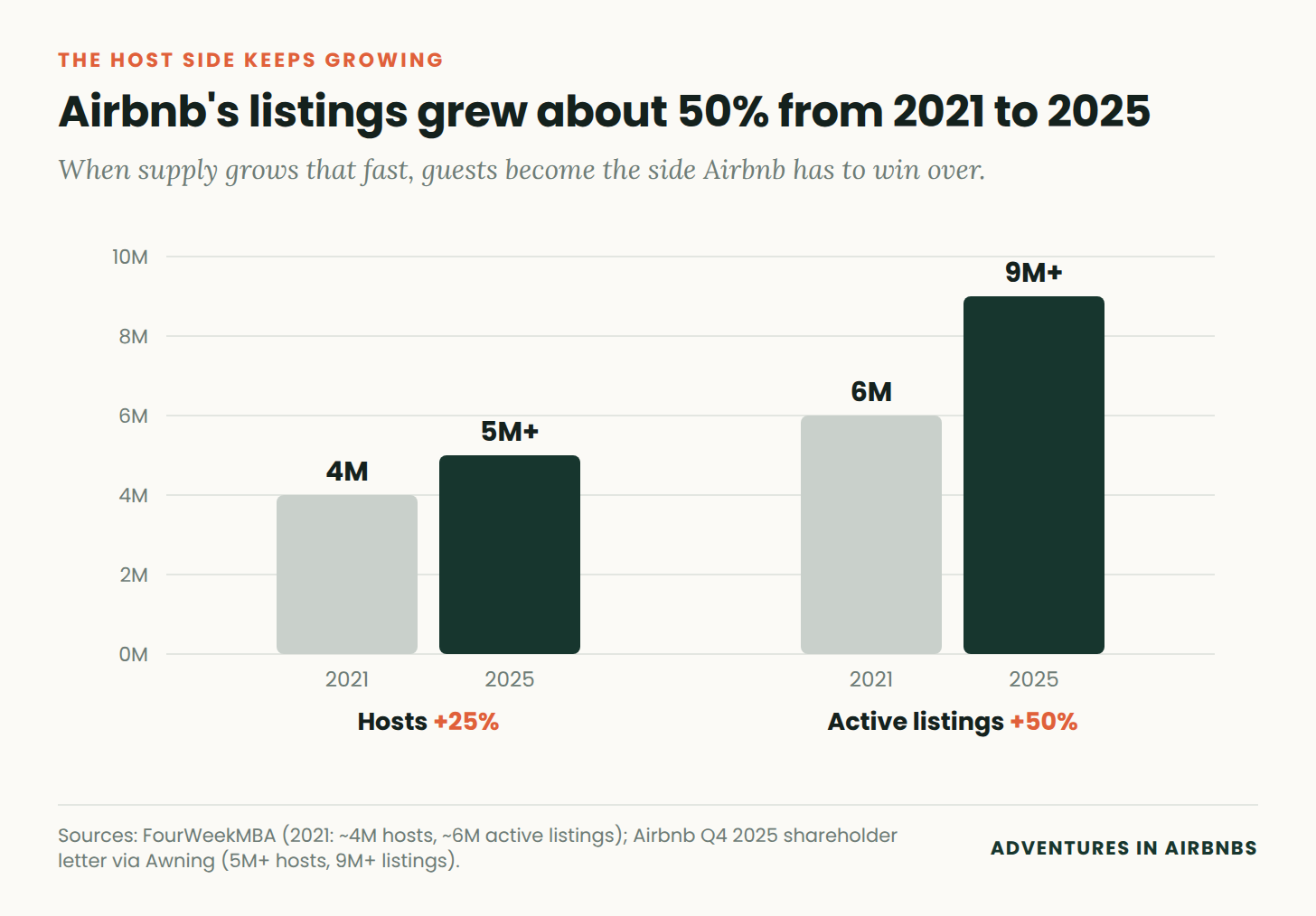
In 2021, Airbnb had about 4 million hosts and 6 million active listings, according to FourWeekMBA. By the end of 2025, Airbnb reported more than 5 million hosts and more than 9 million listings in its Q4 2025 shareholder letter, as summarized by Awning. That’s roughly 50% more listings in four years.
When supply grows that fast, hosts become easy to replace, and guests become the side Airbnb has to win over. So the platform is catering to guests: no chores, no fines, no contracts, no ID uploads, no Wi-Fi email capture. Each of those rules makes the guest experience smoother. Each one also takes a tool away from hosts who were using it to protect their property or build direct bookings.
Here’s what that means in practice:
Your costs go up. Stripping beds and hauling trash don’t disappear. They move to your cleaner, which likely means a higher cleaning fee or nightly rate.
Your leverage goes down. Requests aren’t enforceable. If a guest ignores one, you can’t cancel, and you can’t fine them.
Your direct booking pipeline gets harder. No email capture at login, no reviews or surveys on other sites, and more of the guest relationship stays inside Airbnb.
The upside? Hosts who already ran full turnovers are no longer undercut by listings whose guests did half the cleaning. And guests who book with confidence may book more. But make no mistake about who this policy was written for.
Your to-do list before November 20
Open the new House rules and requests section and set your 7 standard rules, including the two new ones: maximum overnight guests and lock up at checkout.
Rewrite your checkout list as requests. Dishes in the sink, towels in a pile, trash in the indoor bins, A/C off, doors locked. That’s about it.
Hunt down rules hiding elsewhere. Check your listing description, house manual, automated messages, guidebook, and those signs on the fridge. Anything that’s really a rule needs to move into the listing’s rules section, or go.
Delete any fines. Late checkout fines, extra guest fines, “smoking fee” language. Replace them with the standard rules, which let you cancel if they’re broken.
Talk to your cleaner and check your cleaning fee. If guests were stripping beds and taking out trash, your cleaner now does it. Adjust the fee or your rates to match.
Review your contracts and ID collection. If your software sends a rental agreement or ID upload to every guest, check whether you fit one of the exceptions. If your HOA or resort requires it, keep the rule on file and disclose it before booking.
Check your door code and Wi-Fi setup. If guests need an app to get in, offer another way in on request. If you use StayFi or another Wi-Fi login that collects emails, plan to turn it off.
Know your local exceptions. Bear bins, drought rules, HOA requirements, city registration rules. If something is truly required where you are, document it and be ready to appeal a flag.
The days of the four-page checkout checklist are over. Good riddance. Guests are on vacation, we’re in the hospitality business, and the cleaning fee is supposed to cover the cleaning.
How are you handling the change? Are you raising your cleaning fee, or did you already run a no-chores checkout? Do you have a direct booking site (If not, reach out; we can help). Tell me in the comments.
Sources
Important changes to house rules, Airbnb Resource Center, October 20, 2026
Ground rules for home guests, Airbnb Help Center
Airbnb New House Rules Policy: What Hosts Can Ask From Nov 20, Rental Scale-Up, October 21, 2026
Airbnb bans check-out chores like stripping the bed or taking the bins out, Euronews, October 21, 2026
StayFi integration, Uplisting
Airbnb Hosts Number, FourWeekMBA
Airbnb Statistics 2026, Awning
Airbnb House Rules Policy 2026: Contracts, ID & Chores, TabiVista, October 21, 2026