


Here is a question we ask every owner who comes to us frustrated that bookings have slowed down:
How many other short-term rentals are within one mile of your front door?
Almost nobody knows. They can tell us their ADR, their occupancy last August, and the exact hour their cleaner shows up. But the number of listings competing for the same guest, on the same map, in the same mile? Blank stare.
That number is the single most important piece of context for every other decision you make. It changes what a good price looks like. It changes how much a single 4-star review costs you. And it completely changes what it means to be “ranked 40th.”
100 competitors and 1,000 competitors are two different businesses
Start with what does not change.
Say you are sitting at position #40. You are on roughly page three whether there are 120 listings inside your mile or 900. The guest scrolling the map doesn’t care how many properties are stacked up behind you, and does not scroll any further because of them. Buried is buried. Anyone who tells you that “top 4% of your market” is a meaningful consolation is selling you a vanity metric.
What density actually changes is the price of getting out.
Page one is about 18 slots in every market on earth. That number does not scale with your competition.
In the lake town, page one means being top 15%. You have to beat about 100 listings.
In the beach market, page one means being top 2%. You have to beat about 880.
Same destination. Wildly different climb. That is why the same well-meaning advice — “refresh your photos, tighten your title” — produces a happy host in one market and an exhausted one in the other. It is not that the advice is wrong. It is that a gain big enough to carry you onto the top pages in the lake town barely registers as movement through a field of nine hundred.
Density also decides how noisy your rank is
This is the part almost nobody accounts for.
In a 900-listing market, there are hundreds of properties sitting within a rounding error of your score. A single cancellation, one 4-star review, a competitor’s price drop — and you move twenty positions, because twenty listings were stacked within a hair of you. Rank in a dense market is genuinely volatile.
In a 120-listing market, your rank is sticky. There simply are not enough near-neighbors to move you far. You can go a month without shifting three spots.
Same for supply shocks. Fifty new listings arriving before summer is background noise in the beach market and a 40% increase in competition in the lake town.
So “where do I rank” is a stable, once-a-quarter question in one market and a live, moving number in the other. Knowing which one you are in tells you how closely you need to be watching.
And the advice genuinely inverts
Take the most common piece of guidance there is: lower your price 10%.
In the dense market, you have fifty near-identical substitutes and guests are actively comparison-shopping across them. Price is doing real work there — a cut can move you relative to your comp set and win share. But you need to be careful, as a big price cut could drop you in rank. Remember, one of Airbnb’s algorithm goals is to maximize profit. If two properties are equal in amenities, quality, rating, etc., it will place the higher-priced property first.
In the thin market, you are one of a handful of options at your size and layout. A guest who wants a 4-bedroom on that lake in July has nowhere else to go. The same 10% cut mostly hands money back on bookings you were going to get anyway.
Identical advice. Opposite outcomes. The only thing that tells you which situation you are in is knowing how crowded your mile is.
How to actually find your number
You do not need a subscription to get a rough answer:
Open Airbnb on a desktop, zoom the map to your property, until the map is showing about a mile in each direction. Turn on “Search as I move the map.” Clear the dates. The count Airbnb shows you at that zoom level is your real competitive set.
Do it again for each guest count your place sleeps. A 2-bedroom competing at “4 guests” faces a different field than the same place filtered to “6 guests.” Most owners are shocked at how much the number moves.
Do it again in your shoulder season. Supply in a lot of markets is wildly seasonal — the number of listings that switch on for July is not the number competing with you in February.
Write the numbers down with the date. Supply growth is the story of the last three years in most markets, and you want to be able to see it happening to you rather than hearing about it from a podcast.
If you do this once a quarter, you will know more about your market than 90% of the hosts you are competing with. Or keep reading for a much better way to track this.
Bookings does not decline. It falls off a cliff.
We wrote about this a while back in Help — I stopped getting new bookings,
and it remains the most common thing we see: the owner did not do anything obviously wrong, the calendar just went quiet.
The reason it feels so sudden is that airbnb’s algorithm is NOT egalitarian. It will keep rewarding listings that will generate more revenue and happy guests. Page one to three gets almost everything. Page three and lower gets a fraction. By the time you are past page five, in a competitive market, you are functionally not in the search results at all.
The cruel part is that the fall is much faster than the climb. A handful of guest cancellations, one accuracy-related 3-star review, a stale calendar, or a price that drifted out of the band the algorithm expects for your cluster — and you can lose two pages in under a week. Earning them back takes a month of clean stays.
A little about how Airbnb decides
Airbnb has never published the ranking formula, but the shape of it is well understood by anyone who has watched enough listings move. Two things worth internalizing:
First, Airbnb is optimizing for its own revenue and for guest satisfaction — not for your occupancy. Every signal it rewards is a proxy for “will this guest book, will they be happy, and will they come back.” That means:
Click-through rate on your cover photo. Your first image is doing more ranking work than your entire description. If guests scroll past you in the grid, Airbnb learns you are a weak result for that search and stops showing you.
Conversion rate. Views that turn into bookings. A listing with good views and no bookings gets demoted — usually a pricing or photo-set problem.
Review score, and especially review recency and the words in them. Mentions of cleanliness, accuracy, and maintenance issues punch well above their weight.
Reliability signals. Host cancellations are the fastest way to tank a listing. Response time and response rate matter. So does calendar freshness — an un-touched calendar reads as an absentee listing.
Price relative to your comp set, not price in the abstract. This is the one that ties straight back to knowing your market.
Completeness and filter eligibility. Every amenity you have but did not list is a filtered search you silently lose.
Second — and this is the part most hosts miss — there is no single “your rank.” Airbnb ranks per search. Your position for 2 guests, no dates is a different number than for 6 guests, a week in July, pets allowed. It is different for a logged-in repeat guest than a first-time browser. The listing you think is on page one may be on page four for the guest count that actually pays your mortgage.
In addition, a guest searching in a mobile device will see a different rank list due to the properties with ‘mobile discount’.
A good guest (3+ reviews and 4.9 or higher) will also see a different rank list due to the properties offering the 15% discount to ‘good guests’.
So the honest answer to “where do I rank?” is: it depends, and it changes nightly. But you can and should track the rank by number of guests to get a trend.
Every Airbnb owner should be tracking page rank
We will say it plainly: if you self-manage, tracking your search rank should be as routine as checking your calendar.
Not because the number itself is interesting, but because of what it gives you:
Early warning. Rank moves days to weeks before your booking pace does. A slow calendar tells you something broke two weeks ago. A rank chart tells you it is breaking right now, while you can still do something about it.
Attribution. Change the cover photo, then watch. Change the title, then watch. Drop the price $12, then watch. Without a daily rank record, you are making five changes at once and guessing which one worked — which is how most hosts end up making their listing worse over a season.
Sanity. Half the time the chart shows the whole market moved, not you. That is enormously useful information. It stops you from panic-discounting into a slow week that was never your fault.
Proof for the money conversations. If you are a co-host or you own with a partner, “our rank went from 45th to 8th over six weeks” is a much better report than “I think things are going well.”
The free tool we use: ListingSonar
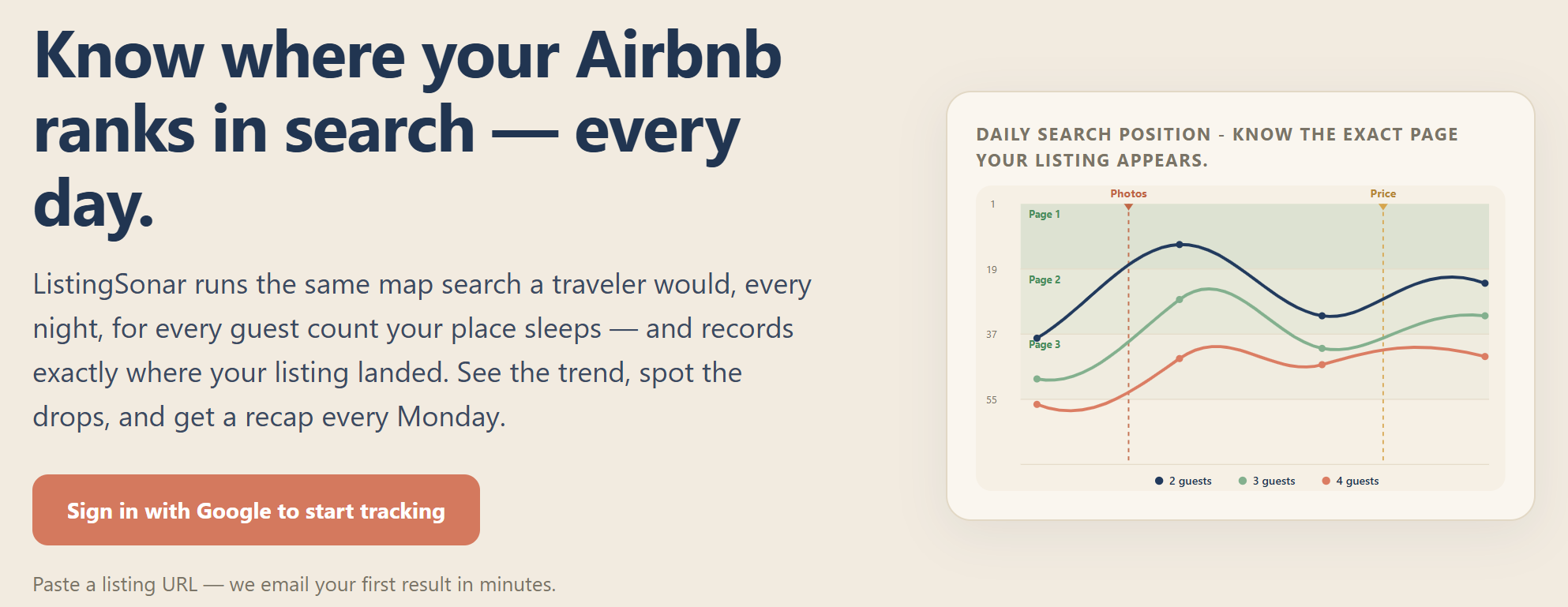
ListingSonar is a free Airbnb rank tracker, and it is the easiest way we have found to do all of this without a spreadsheet habit.
What it does:
You paste in your Airbnb listing URL. It reads the name, the location, and how many guests the place sleeps. That is the entire setup.
Every night it runs the same dateless map search a traveler would — about a one-mile radius around your property, not logged in, so you are seeing the real result and not a personalized one — and records exactly where your listing landed.
It does this once per guest count you sleep (1, 2, 3, 4 and up), so you can see the searches you are quietly losing.
The dashboard shows page-one bands, so you can see at a glance the day you fell off page one instead of doing the math on position numbers.
It shows the number of competing listings alongside your rank — which is the market-density number this whole post is about, tracked for you over time.
You can log changes — new photos, new title, price move — and see them marked on the chart, so you can actually tell what caused what.
History from 14 days out to a year, and a Monday morning email recap of what moved.
Multiple properties under one account, and property managers can have recaps emailed to owners directly.
It is free. Sign in is Google only — no password to create, and the first result lands in your inbox within minutes.
The takeaway
Two numbers, checked regularly, will tell you more about the health of your short-term rental than anything else on your dashboard:
How many listings are inside your mile — the size of the fight.
Where you sit among them, every night — whether you are winning it.
Most owners know neither. That is the opportunity. In a market that has spent three years adding supply faster than it adds guests, the hosts who survive are simply the ones who noticed the drop while it was still a dip.
Go find your number. Then go watch it.
P.S. — If you are in one of the markets we operate in and want a second set of eyes on your listing, reply to this email. And if you start tracking your rank and see something strange in the chart, send us a screenshot. We love this stuff.