


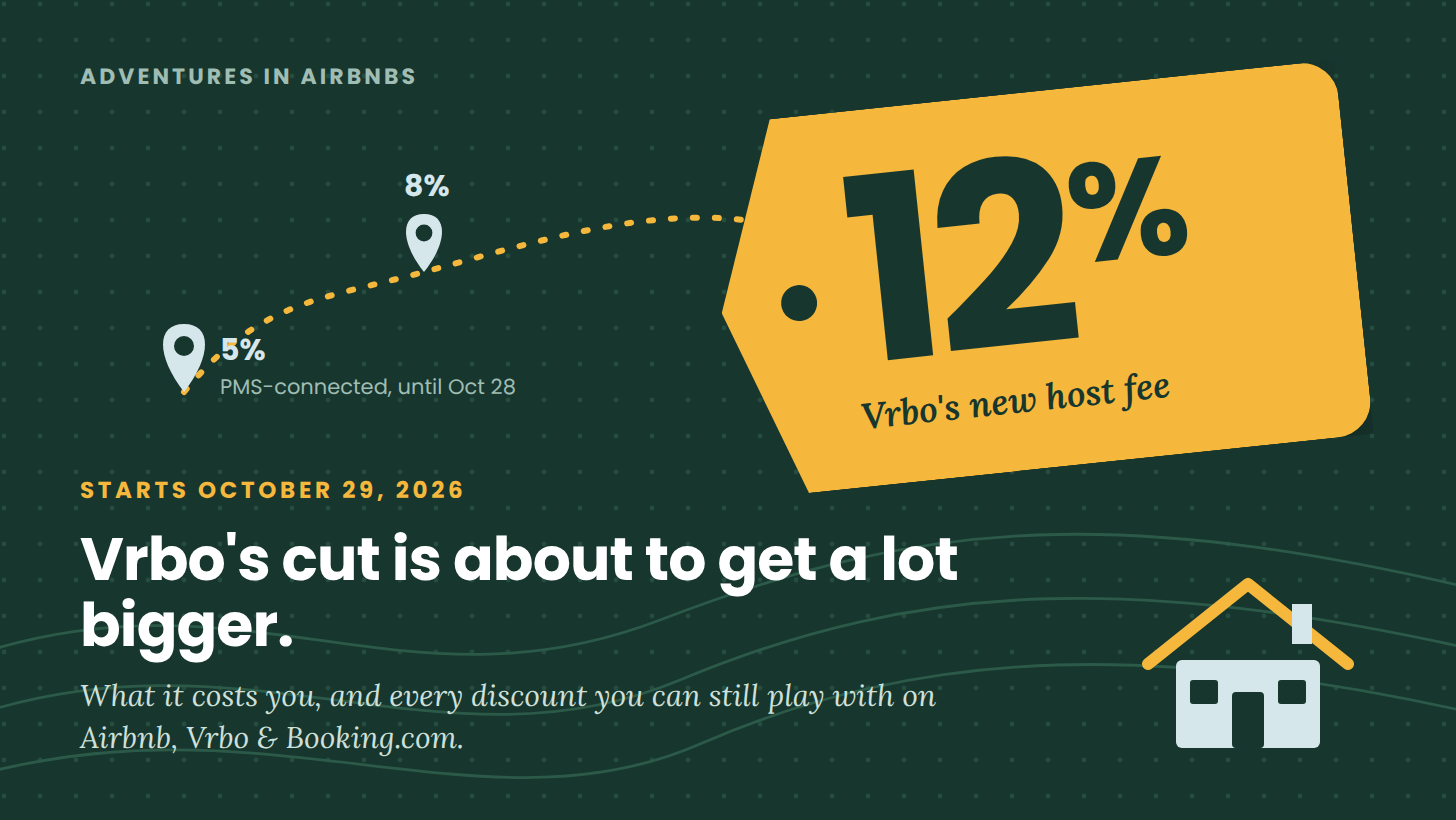
Starting October 29, 2026, Vrbo charges every host a flat 12%. That’s up from 5% if you’re connected through a PMS, about 8% if you list directly, and a few hundred bucks a year if you’re a legacy subscription host. Vrbo is also shrinking the guest fee and adding a rate parity clause. Below: the real dollar cost, how Vrbo now compares to Airbnb and Booking.com, and a full cheat sheet of every discount you can offer on all three platforms.
Well, it finally happened. Vrbo looked at Airbnb’s 15.5% host fee, looked at Booking.com’s 15%, looked at its own modest 5%, and apparently decided it was leaving money on the table.
Starting October 29, 2026, Vrbo will take a flat 12% commission from every host and property manager on the platform. For most of us, that’s somewhere between a 50% and 140% jump in what we hand Vrbo on every single booking.
If you connect through a property management system, you’ve been paying 5%. If you list directly on Vrbo, you’ve been paying about 8% once payment processing is included. And if you’re one of the lucky long-timers still on an annual subscription, you’ve been paying a flat few hundred dollars a year, which was quietly the best deal in vacation rentals. All three groups now land on the same number: 12%.
Skift broke the story on September 29 under the headline “Vrbo to Double Commissions as It Plays Catch-Up to Airbnb.” If you’re a PMS user, that headline is being polite. Going from 5 points to 12 points isn’t doubling. It’s a 140% increase.
There’s a trade-off hiding in the fine print, though. Vrbo says it will “drastically” reduce the service fee guests pay at checkout, which has been running 11% to 14%. So the total price a traveler sees may not move much. What moves is who gets the bill, and how much of each booking actually makes it to your bank account.
And there’s a second change riding shotgun that matters just as much: a rate parity clause. Vrbo will require your Vrbo rates to be at least as low as any other channel, including your own direct booking website. That one sentence breaks the classic “just mark up Vrbo to cover the fee” move.
Here’s the trail map for today’s hike:
What exactly is changing at Vrbo, and what it costs you in real dollars.
How Vrbo now stacks up against Airbnb and Booking.com.
A full recap of every discount and promotion you can offer on Airbnb, Vrbo and Booking.com, plus a cheat sheet and a playbook for using them without giving away the farm.
That discount section matters a lot more than it did a month ago. When every platform takes 12% to 18% off the top, every discount you run sits on top of that fee. A 15% promotion on a 15% platform isn’t a 15% haircut. It’s a buzz cut. And most hosts never do the math.
Let’s do the math.
What’s actually changing at Vrbo
The short version: on October 29, three different fee arrangements get squished into one 12% commission.
Here’s how Vrbo charged hosts until now, based on Hostfully’s breakdown (updated May 2026) and Skift’s reporting:
PMS or channel-manager connected: 5% commission, with processing handled through your software. New rate: 12%. That’s +7 points.
Listed directly on Vrbo, pay-per-booking: 5% commission plus 3% payment processing, about 8% total. New rate: 12%. That’s +4 points.
Legacy annual subscription: $499 to $699 per listing per year. New rate: 12%. A flat fee becomes a percentage. Ouch.
Who’s affected?
Everyone. Skift reports that legacy subscription hosts, about 6% of Vrbo listings globally and 12% in the U.S. according to AirDNA, will also move to 12%. The subscription has been closed to new hosts for years, but plenty of long-time owners kept renewing because it was a steal for a busy listing. The steal is over.
PMS-connected property managers take the biggest hit in percentage points. Vrbo used to reward software connections with the lowest rate on the platform. That incentive is gone, which is a little funny considering Vrbo spent years begging managers to connect through APIs.
What does 12% apply to?
Vrbo’s current 5% commission applies to the nightly rate plus mandatory fees like cleaning, pet and extra-guest fees, but not refundable security deposits. Expect the 12% to follow the same base. Your cleaning fee is not a commission-free zone.
One open question as of this writing: whether the 12% is all-in, or whether hosts who list directly still pay a separate payment processing charge on top. The reporting describes a single flat commission. Check your Vrbo partner dashboard and any notice emails before you reprice.
The guest fee is shrinking (but not disappearing)
Vrbo guests have been paying a service fee of roughly 11% to 14% at checkout. Vrbo says it will drastically reduce that fee, but also said that “in most cases travelers will still see a service fee applied.” So this isn’t a full Airbnb-style move to host-only pricing. It’s a partial shift of the fee from the guest’s side of the receipt to yours.
The rate parity clause
The updated terms require your Vrbo rates to be at least as low as the rates you offer anywhere else, including your own website. The update also lets Vrbo distribute your listing through AI agents and metasearch.
If you’ve been growing direct bookings by offering a lower price on your own site, read that clause twice. Maybe three times. We’ll come back to it in the strategy section.
The math: what 12% actually costs you
Percentages hide the pain. Dollars don’t.
One booking
Picture a typical five-night stay: $340 a night plus a $300 cleaning fee, for a $2,000 booking subtotal.
PMS-connected host: your payout drops from $1,900 (5% fee) to $1,760 (12% fee). You just lost $140 on one stay.
Direct-listed host: your payout drops from $1,840 (about 8%) to $1,760. You lost $80.
That’s one booking. That’s a nice dinner out. Now multiply it by a year.
A year of bookings
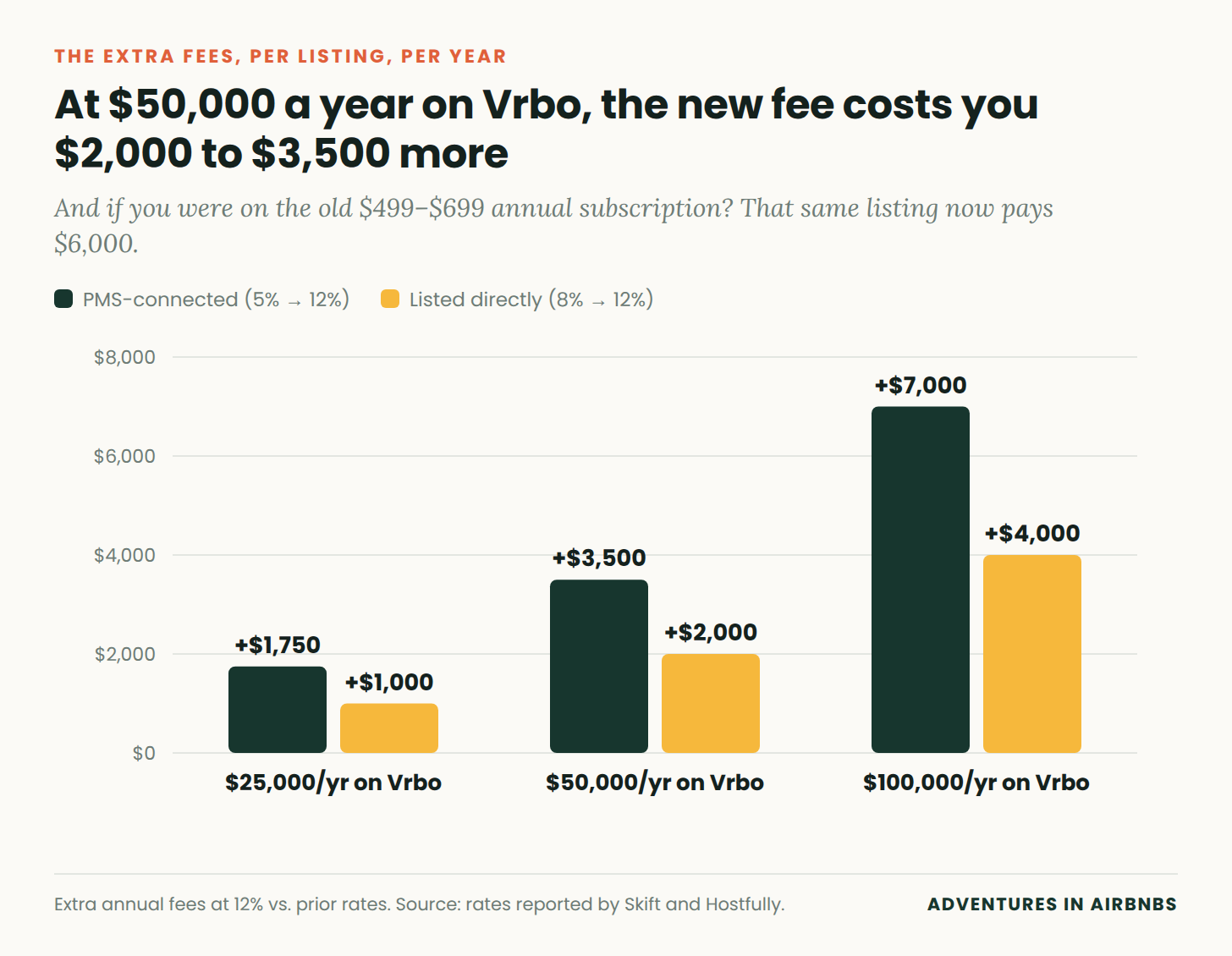
$25,000 a year on Vrbo: +$1,750 for PMS hosts, +$1,000 for direct hosts. A subscription host now pays $3,000 instead of $499 to $699.
$50,000 a year: +$3,500 for PMS hosts, +$2,000 for direct hosts. A subscription host now pays $6,000.
$100,000 a year: +$7,000 for PMS hosts, +$4,000 for direct hosts. A subscription host now pays $12,000.
Subscription hosts, I see you, and I’m sorry. A $100,000 listing that paid $699 a year now pays $12,000. That’s not a fee increase. That’s a brand-new line on your P&L that needs its own name.
How much do you need to raise rates to break even?
This is where most hosts trip on a root. You can’t just add 7% to your price to cover a 7-point fee increase, because the new fee gets charged on the new, higher price. The fee eats part of your raise.
Here’s the formula. Tape it to your fridge:
Required price increase = (1 − old fee) ÷ (1 − new fee) − 1
From 5% to 12%: 0.95 ÷ 0.88 − 1 = 7.95% higher prices to keep the same payout.
From 8% to 12%: 0.92 ÷ 0.88 − 1 = 4.55% higher prices.
From a subscription (roughly 1% of revenue on a busy listing) to 12%: 0.99 ÷ 0.88 − 1 = about 12.5% higher prices.
The silver lining: the guest-side offset
If Vrbo cuts its guest fee like it promised, your guest’s total might not go up even if you raise your rate.
Say a guest used to pay your $2,000 subtotal plus a 12% service fee, for $2,240 total. You raise your rate 4.55% to $2,091. If Vrbo’s guest fee drops to something like 5% (Vrbo hasn’t published the new number, so treat this as a made-up example), the guest now pays about $2,196. That’s less than before, and you kept your payout. Everybody wins, except maybe your spreadsheet.
That’s exactly the bet Vrbo is making. Whether it works for you depends on the final guest fee, and on that parity clause, which limits where you’re allowed to raise prices.
Why is Vrbo doing this?
Vrbo is chasing the checkout price. Airbnb proved that showing guests one clean, fee-free number converts better, and Vrbo wants the same magic without giving up revenue.
Airbnb went first
Airbnb spent the past year moving almost every host to a single host-only fee of 15.5%. According to Rove Travel’s rollout timeline, PMS-connected hosts moved in late 2025, most independent hosts followed on December 1, 2025, and the last non-EU holdouts switched on September 15, 2026, with EU hosts following on October 13. Under the old split model, hosts paid 3% and guests paid 14% to 16.5% on top.
Now the guest sees one price. No “wait, what’s this?” moment at checkout. Skift quotes a Wall Street analyst who says Vrbo’s change “is aimed at replicating the conversion gains Airbnb saw when it showed travelers a no-fee price.”
Vrbo’s own spin is that 12% brings it in line with “industry standards.” Booking.com charges hosts about 15% with no guest fee. Airbnb charges about 15.5%. So at 12%, Vrbo is still the cheapest of the three, at least on paper.
Hosts are already paying for Vrbo’s growth
This fee change didn’t come out of nowhere. In its Q2 2026 earnings coverage, Rental Scale-Up reported:
Expedia’s consumer segment, which includes Vrbo, grew bookings 8%, its fastest U.S. growth in 15 quarters.
Supplier-funded promotions, meaning discounts hosts pay for out of their own rates, now make up more than 40% of Vrbo bookings, up from about a third in Q1 2026.
Expedia’s May 2026 sale crossed $1 billion in bookings for participating properties for the first time.
Read that second bullet again. Four out of ten Vrbo bookings already carry a host-paid discount, usually 10% to 30%. Now the commission on that discounted price goes up too. Hosts are paying twice for the same visibility: once in the promotion, and again in the fee. It’s like tipping the valet and then paying for parking.
Metasearch, AI agents and the parity clause
The new terms let Vrbo push your listing through metasearch and AI agents. That’s where travel search is headed, and Expedia wants inventory it can distribute everywhere at a price nobody can undercut. The parity clause is how it guarantees that. If an AI travel agent or a Google result sends a guest to Vrbo, Vrbo doesn’t want that guest finding a cheaper price on your website five minutes later.
The bigger picture
The three big platforms are converging. All of them now take 12% to 18% from the host, all of them are shrinking or eliminating the guest fee, and all of them are leaning on host-funded promotions to decide who ranks. Airbnb CEO Brian Chesky has even called sponsored listings an “obvious” opportunity worth roughly $1 billion a year, according to Lodgify’s September roundup.
The era of cheap OTA distribution is over. The hosts who win from here will be the ones who know exactly what each channel costs them, after fees and after discounts.
How Vrbo stacks up against Airbnb and Booking.com
Even after the increase, Vrbo takes the smallest cut of the big three: 12%, versus 15.5% at Airbnb and about 15% at Booking.com before payment processing.
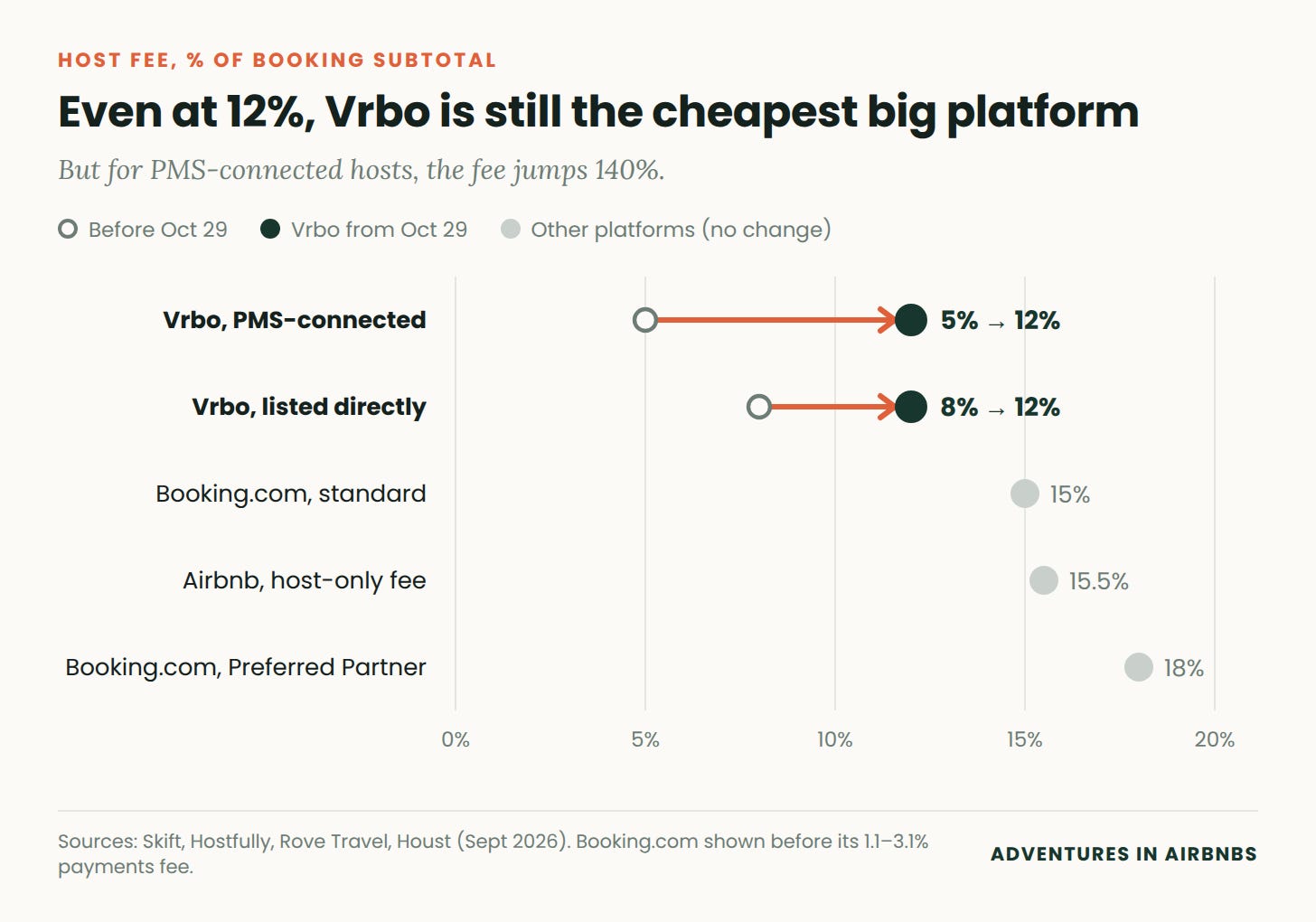
Here’s why it stings anyway. Vrbo’s advantage used to be huge: a PMS-connected host paid less than a third of what Airbnb charges. After October 29, the gap shrinks to 3.5 points.
A few things the chart can’t show you:
Guest fees. Airbnb has almost completely eliminated its guest fee. Booking.com doesn’t charge one. Vrbo will still charge guests a reduced service fee in most cases, so Vrbo’s all-in guest price may still be a bit higher at the same nightly rate.
Booking.com’s range. Booking.com’s commission runs 10% to 25% depending on country and property type, with a global average around 15%, per Houst. Payments by Booking.com adds 1.1% to 3.1%. Genius discounts, which most properties need for visibility, add more real cost on top.
Airbnb exceptions. Hosts in Brazil and Mexico pay 16%, and listings with Super Strict cancellation policies can pay more, according to Hostfully.
Who takes what from a $1,000 booking
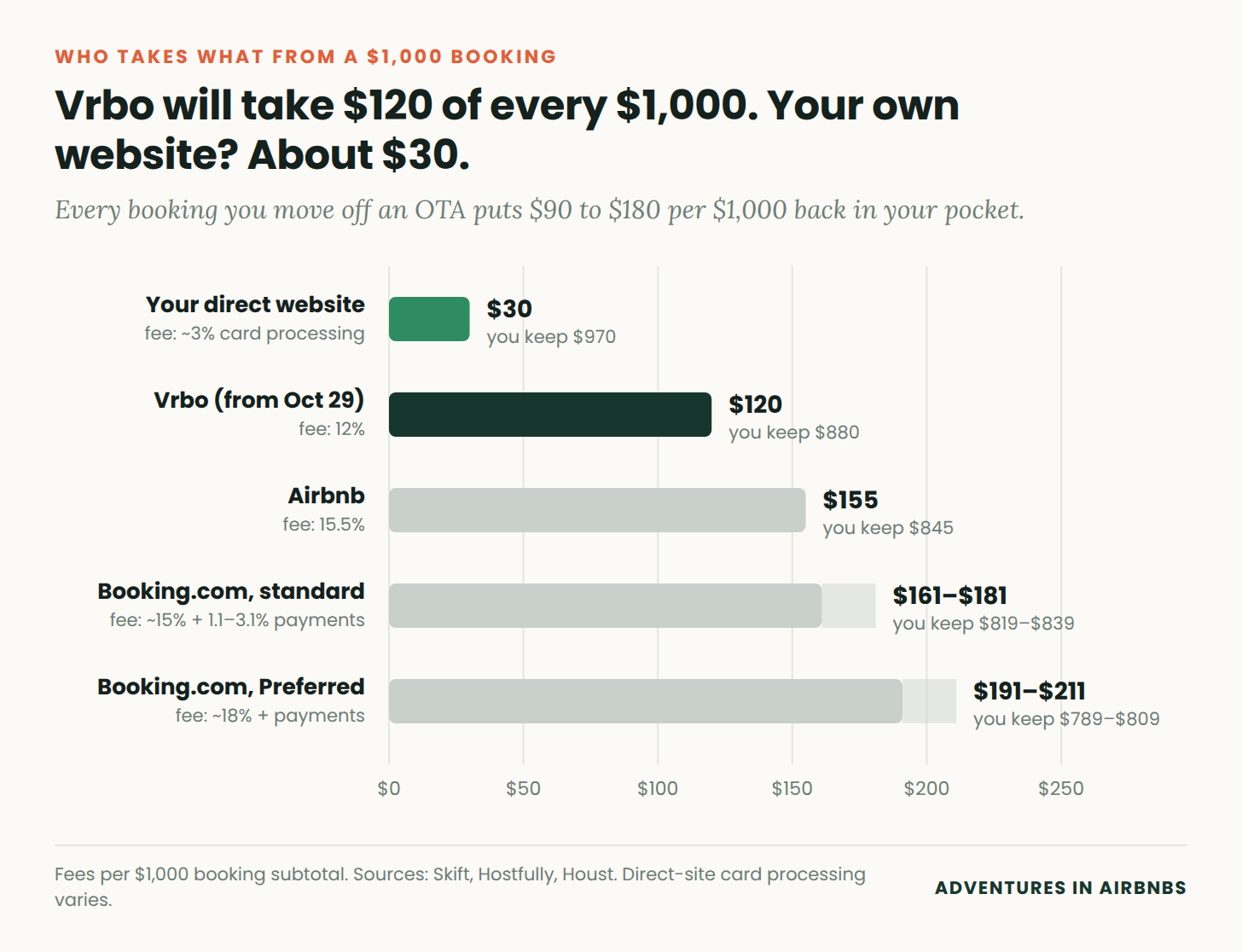
Your direct website: about $30 in card processing. You keep about $970.
Vrbo, after October 29: $120. You keep $880.
Airbnb: $155. You keep $845.
Booking.com, standard: $161 to $181 with payments. You keep $819 to $839.
Booking.com, Preferred Partner: $191 to $211. You keep $789 to $809.
That first line is the one that should make you sit up. Every booking you move from an OTA to your own site is worth $90 to $180 per $1,000. The parity clause makes that harder, but not impossible.
What to do before October 29
First, don’t rage-delist. At 12%, Vrbo is still cheaper than Airbnb and Booking.com. What you should do is reprice on purpose, tighten your discounts, and rethink how you compete on your own website.
1. Know your real Vrbo share
Pull the last 12 months from your PMS or payout reports. What share of your revenue came from Vrbo, and what was your average booking value? A listing where Vrbo drives 40% of revenue needs a real plan. A listing where Vrbo drives 5% can probably shrug and move on.
Look at booking quality too. Vrbo guests have traditionally skewed toward families and longer stays. If your Vrbo bookings are longer and easier than your Airbnb bookings, that’s worth something beyond the fee line.
2. Reprice everywhere, not just on Vrbo
The old trick was a channel markup: charge a few percent more on the channel that charges you more. The parity clause blocks that in one direction. Your Vrbo rate can’t be higher than your rate elsewhere.
So the math nudges you toward raising your base rate across all channels. Raise 4.5% to 8% everywhere and you protect your Vrbo margin, and you also get a small bump on direct bookings, where you pay no commission at all. Watch your occupancy for a few weeks and adjust.
If you use dynamic pricing like PriceLabs, Wheelhouse or Beyond, update your base price and minimums instead of fighting the tool with a pile of manual overrides.
3. Win direct bookings on value, not price
Lots of us offer a lower rate on our direct booking site. Under the new Vrbo terms, that may violate parity, depending on how Vrbo defines “rate” in the final agreement.
Good news: you still have plenty of ways to make booking direct the better deal without undercutting your nightly rate.
No guest service fee. Your site never charges one. If Vrbo still adds a service fee, your checkout total is lower even at the same nightly rate.
Perks, not discounts. Free early check-in, late checkout, a stocked welcome basket, a bundle of firewood, a beach cart, or a credit at the taco place down the street.
Flexibility. A friendlier cancellation or date-change policy for direct guests.
Returning guest love. A thank-you gift or first dibs on dates for repeat visitors.
Read the final parity language carefully before you change anything. Some parity clauses treat member-only rates or packages differently from public rates.
4. Rethink your cleaning fee
The commission applies to cleaning and other mandatory fees. At 12%, a $300 cleaning fee now costs you $36 in commission every stay. That’s not a reason to drop the fee. It’s a reason to stop thinking of it as pass-through money.
5. Audit every promotion you’re running
Four in ten Vrbo bookings now carry a host-funded promotion. If you turned on an early-booking or last-minute promotion a year ago and forgot about it, you’re about to pay 12% on a discounted rate. The discount recap below will help you decide what stays and what goes.
6. Subscription hosts: budget for it now
If you’re on the annual subscription, your costs are about to jump by thousands of dollars per listing. Update your 2027 budget and cash flow projections now, and loop in your CPA so there are no surprises at tax time.
7. Lean on your software
If you’re PMS-connected, ask your provider how they’re handling the change, whether per-channel pricing rules still work, and how they’ll flag parity conflicts. Your PMS is now your best defense against accidentally breaking a platform agreement at 11 p.m. on a Tuesday.
Airbnb discounts: the full menu
Airbnb now gives hosts nine discount tools, and more of them stack than most hosts realize. The standard promotions fight each other for the same night, but rule sets, the non-refundable rate and Airbnb’s two shiny new discounts pile on top. These rules come from Hospitable’s discount guide and Homesberg’s 2026 promotions guide.
New listing promotion
What it is: 20% off your first three bookings.
Who qualifies: Listings with fewer than three bookings and Smart Pricing turned off.
Why use it: New listings have no reviews and no ranking history. The promo buys early bookings, and early bookings buy reviews. Most hosts should flip this on.
Custom promotions
What it is: A limited-time discount on specific dates you choose.
Who qualifies: Listings with at least three prior bookings and at least one in the past 365 days. Dates must be available and open at least 28 days out.
Limits: You can’t promote more than 50% of nights in a month, and the promoted price can’t exceed your highest booked nightly rate from the past year.
Display: Discounts of 15% or more get a special callout in search. Promotions covering at least seven consecutive nights stand out more.
The catch: Custom promotions don’t combine with your weekly or monthly discounts.
Weekly and monthly discounts
What it is: A percentage off stays of 7+ nights (weekly) or 28+ nights (monthly). You can also set custom length-of-stay tiers.
Display: 10% or more shows up in search results.
Why use it: Longer stays mean fewer turnovers, fewer cleanings and less wear and tear. On a 15.5% platform, the savings on turnovers often beat the discount.
Early-bird discount
What it is: A discount for guests who book 1 to 24 months ahead.
Display: Even 3% triggers a callout on your listing.
Why use it: A tiny early-bird discount is one of the cheapest marketing tricks on Airbnb. It locks in far-out dates for pocket change.
Last-minute discount
What it is: A discount for bookings made close to check-in, from 0 to 28 days before arrival.
Display: 10% or more shows in search results.
Why use it: Fills gap nights that would otherwise earn exactly zero dollars. Homesberg suggests stepping it up as the date gets closer instead of using one flat number.
Non-refundable rate
What it is: Guests choose between your standard cancellation policy or a cheaper non-refundable rate, typically about 10% off.
Why use it: Locks in revenue with zero cancellation risk. Great for peak season and big event weekends.
Rule sets (seasonal pricing)
What it is: Pricing and availability rules applied across multiple listings and date ranges. Mostly used by hosts with professional tools.
Why use it: Keeps seasonal adjustments consistent across a portfolio.
Top-rated guest discount (new in 2026)
What it is: 15% off for guests with an average rating of 4.8 or higher and at least 3 reviews from other hosts.
Rules: Airbnb sets the 15%; you can’t adjust it. Smoobu reports the promotion ends automatically after your listing gets three discounted bookings.
Why use it: It rolls out the welcome mat for guests with a proven track record of not throwing parties in your living room.
Mobile-only discount (new in 2026)
What it is: 10% off for guests who book in the Airbnb app. Desktop and mobile web guests see your regular price.
Rules: Fixed at 10%. For now it’s only available through connected software that supports it, per Hostaway. Rental Scale-Up reports hosts can’t change the percentage or exclude high-demand dates.
Why use it: Airbnb is pushing app bookings hard, and this is the toll for riding in that lane.
How Airbnb stacks discounts (spoiler: more than you think)
The five standard promotions compete, so only one of them applies to a given night, in this priority order (per Airbnb):
New listing promotion
Custom promotion
Length-of-stay discount
Early-bird discount
Last-minute discount
But that’s just round one. Everything else layers on top, and each discount is calculated on the already-discounted price. Smoobu lays out the full order:
Rule sets apply first. Inside a rule set, nightly and weekend adjustments apply, then length-of-stay discounts, then early-bird and last-minute discounts (Airbnb). Yes, that means a rule set can stack a weekly discount and a last-minute discount.
One standard promotion from the list above.
Non-refundable discount. Airbnb says the 10% non-refundable discount “applies to your nightly price after all other discounts are calculated.”
Mobile-only discount.
Top-rated guest discount.
Airbnb’s own example: a rule set drops your $120 night to $100, a 20% custom promotion takes it to $80, and the non-refundable discount takes it to $72. That’s 40% off your base price, and nobody sent you a warning email.
Now throw in the new kids. A $300 night with a 10% weekly discount, the 10% mobile-only discount and the 15% top-rated guest discount comes to $206.55, about 31% off. After Airbnb’s 15.5% fee, you keep $174.54. That’s 58% of your list price, for a guest you probably would have been thrilled to host at full price.
One caveat: Rental Scale-Up notes that Airbnb’s help text still says only one offer applies per reservation, while channel managers report that the new discounts stack. Until Airbnb clears that up, open the guest price preview before you turn anything on.
What you actually get for discounting
Airbnb rewards discounts with strikethrough pricing in search and on the listing page, callout badges, a line item in the price breakdown and, sometimes, a spot in guest emails. One useful finding from Homesberg’s testing: a promotion and a straight price cut of the same size rank about the same. The promotion mostly buys you the shiny strikethrough, not an algorithm boost.
Vrbo discounts: the promotions suite
Vrbo’s promotions are simpler than Airbnb’s, and the magic number is 5%. Offer at least 5% off, and Vrbo boosts you in search, slaps a badge on your listing, and lets travelers filter for you. Vrbo launched its promotions suite in May 2025 (here’s the announcement), and these rules come from Guesty’s Vrbo promotions guide and The Host Report.
Early-booking promotion
What it is: A discount for stays booked at least 60 days before check-in.
Minimum: 5% to earn the badge and strikethrough. Vrbo recommends 10%.
Why use it: Vrbo guests tend to plan family trips way ahead. Early-booking deals lock in peak weeks before your neighbors start slashing prices.
Last-minute promotion
What it is: A discount for bookings made within 30 days of check-in.
Minimum: 5% for the “Last Minute” badge and a spot in the dedicated search filter. Vrbo recommends 10%.
Why use it: Fills gaps. Beyond Pricing notes you can choose which listings participate and customize the window.
Mobile-only promotion
What it is: A discount shown only to travelers on the Vrbo app or mobile web.
Minimum: 5% for the badge. Vrbo recommends 10%.
Why use it: Nearly half of Vrbo bookings happen on a phone, according to The Host Report. Probably from the passenger seat.
Member-only deals (One Key)
What it is: A discount for members of Expedia Group’s One Key loyalty program, which Vrbo says has 168 million members.
Minimums by tier: Blue 10%, Silver 11%, Gold 12%. Must be a percentage discount.
Why use it: Expedia says loyalty members book earlier, stay longer and spend more. It’s also a way to discount without showing a lower public rate, which may matter under parity. Confirm how the new terms treat member rates.
New listing promotions
What it is: Enhanced promotion tools for a property’s first 90 days on Vrbo.
Why use it: Same logic as Airbnb. Early bookings build the reviews that drive ranking.
Weekly and monthly discounts
What it is: Standard length-of-stay discounts set in your rates.
The catch: The Host Report points out that, unlike promotions, standard weekly and monthly discounts don’t get a search boost.
How Vrbo stacks discounts
Promotions don’t stack with each other. If more than one applies, the highest percentage wins.
Lodging rate discounts, like length-of-stay, can stack with one promotion.
The maximum total discount is 75% off your base rate.
You can’t edit a promotion’s discount after you create it. You have to end it and start a new one.
The big picture
Vrbo leans on promotions harder than anyone. More than 40% of Vrbo bookings now carry a host-funded promotion. Starting October 29, every one of those discounted bookings also pays 12%. A 10% promotion plus a 12% fee means you keep about 79% of your list price, down from about 85.5% under the old 5% PMS rate. Use promotions like hot sauce: a little goes a long way.
Booking.com discounts: the most options, the most ways to hurt yourself
Booking.com has the deepest discount menu of the three, and like Airbnb, it lets several discounts stack on one reservation. That makes it powerful, and very dangerous. Sources: Houst’s Genius guide, Rentals United on promotions and mobile and country rates, and Zeevou’s promotions review.
Genius program
What it is: Booking.com’s loyalty program. You give Genius members a discount in exchange for more visibility and a Genius badge.
Who qualifies: At least 3 reviews and an average score of 7.5 or higher. No sign-up fee and no extra commission.
Discount levels: Level 1 (guests with 2+ stays) at least 10%. Level 2 (5+ stays) 10% to 15%, with optional perks like breakfast or upgrades. Level 3 (15+ stays) 10% to 20%, plus optional perks.
What it gets you: Houst reports about 70% more search views and 45% more bookings for Genius properties.
2026 change: Booking.com moved Genius visibility to algorithmic matching. Properties offering only the 10% minimum now see fewer impressions, while 15% to 20% or added perks get better ranking.
Basic Deal
What it is: A general-purpose deal you can target to specific dates, lengths of stay or audiences, including a version only signed-in Booking.com users or newsletter subscribers can see (often called a Secret Deal).
Early Booker Deal
What it is: A discount for guests who book well ahead.
Stacks with: Genius, Business Rate, Country Rate and Mobile Rate.
Doesn’t stack with: Last-minute Deal, Secret Deal, Free Nights Deal and campaign deals.
Last-minute Deal
What it is: A discount for bookings made shortly before check-in, commonly within 7 days.
Stacking: Same lists as the Early Booker Deal.
Mobile Rate
What it is: A discount shown only to guests on mobile.
Minimum: 10%.
What it gets you: Rentals United cites up to 28% more visibility.
Stacks with: Most discounts and promotions, but not Country Rates or a Limited-time Deal.
Country Rate
What it is: A discount shown only to travelers in countries you pick. Handy for targeting domestic travelers or a strong feeder market.
Minimum: 5%.
Stacks with: Most discounts, but not Mobile Rates.
Free Nights Deal
What it is: Guests get one or more free nights when they book a minimum number of paid nights, like “stay 7, pay 6.”
Why use it: Pushes longer stays without showing a lower nightly price.
Limited-time Deal
What it is: A short, deep discount that gets a strong ranking boost while it runs.
Who qualifies: Properties with a review score of 7.0 or higher.
Seasonal campaign deals
What it is: Booking.com-run campaigns like Getaway Deals, Black Friday and New Year promotions, with big platform-wide visibility.
Non-refundable and weekly or monthly rate plans
What it is: Separate rate plans rather than promotions: a discounted non-refundable plan, or weekly and monthly rates.
The catch: Zeevou notes these give steady visibility but no strikethrough pricing.
Paid visibility programs
Preferred Partner: About 3% extra commission (roughly 18% total) for about 65% more page views.
Preferred Plus: About 8% extra commission (roughly 23% total), for top-performing partners.
Visibility Booster: A pay-per-booking commission bump on dates you choose.
How Booking.com stacks discounts (a cautionary tale)
This is where hosts get burned. Promotions generally don’t combine with each other, but they do stack with Genius, Mobile Rates, Country Rates and Business Rates, and the discounts apply one after another.
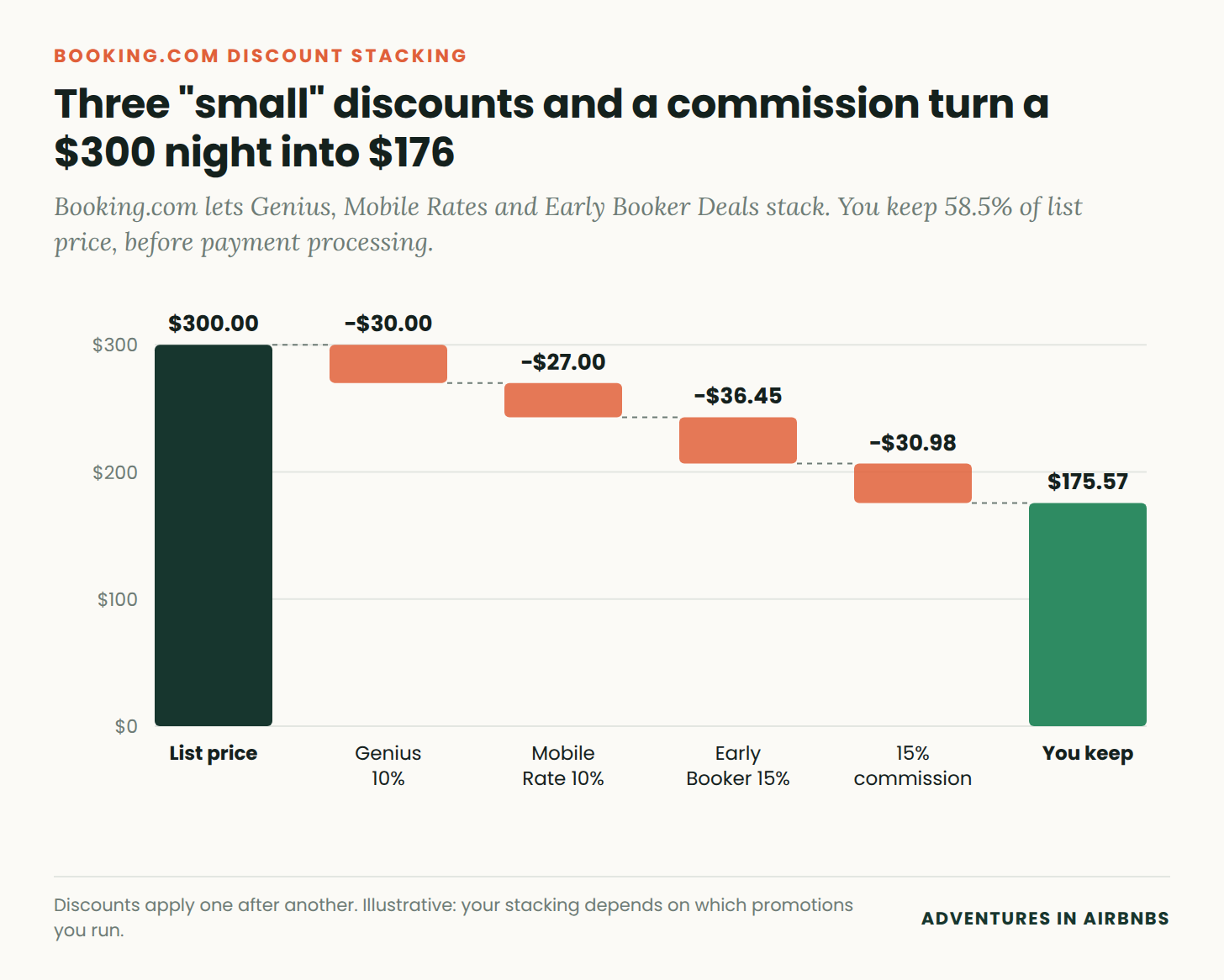
A 10% Genius discount plus a 10% Mobile Rate plus a 15% Early Booker Deal compounds to about 31% off. Add a 15% commission and payment processing, and you keep under 60% of your list price. That’s not a promotion. That’s a donation.
The cheat sheet: every discount on every platform
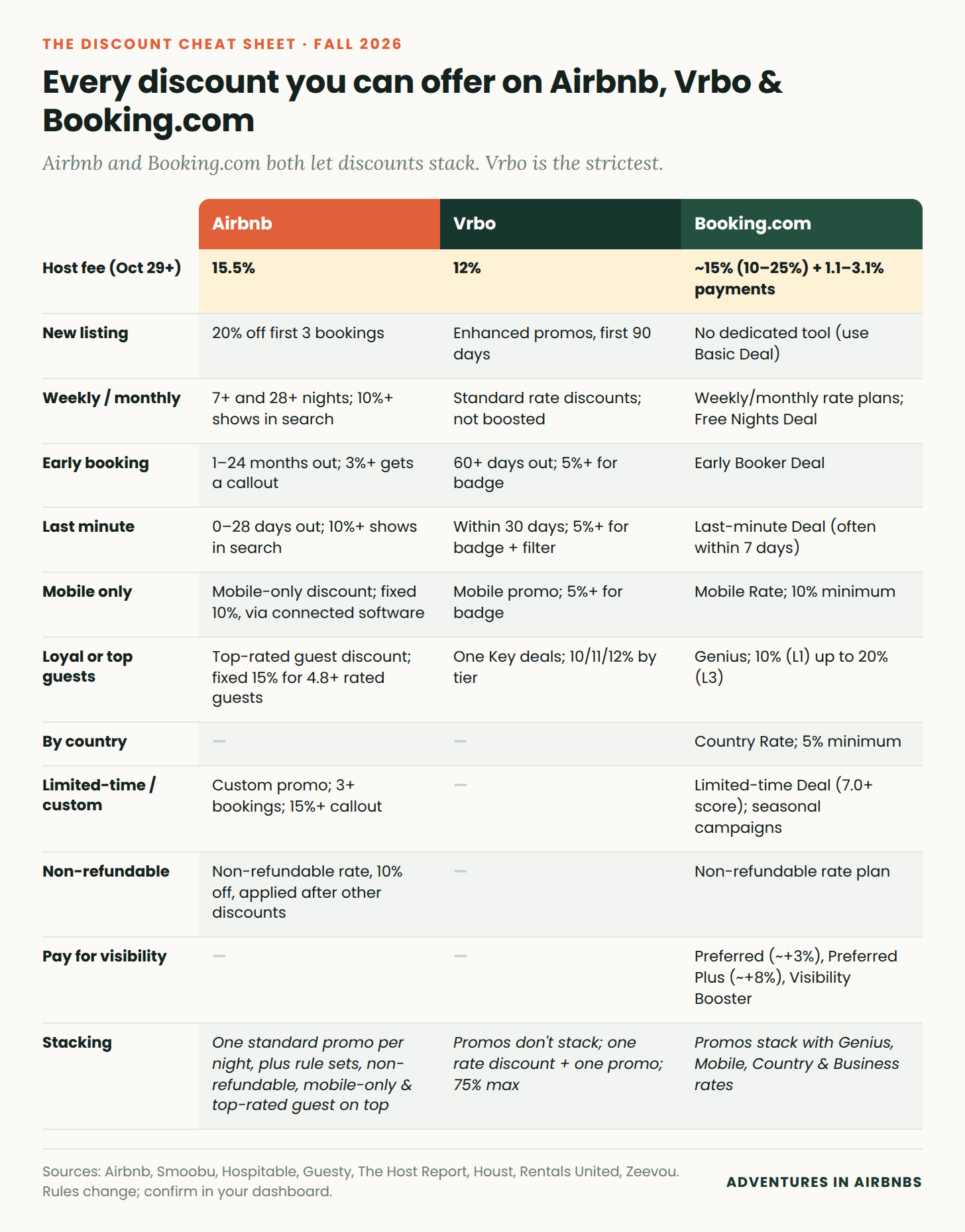
Booking.com has the most discount types. Airbnb and Booking.com both stack. Vrbo is the strictest about combining. Here’s the whole menu on one page. Screenshot it, print it, stick it on the fridge next to the formula.
A discount playbook for the 12%-to-18% era
Every discount now rides on top of a double-digit platform fee. The rule: discount for a reason, measure what you keep, and turn it off when it stops working.
1. Do the net math, every time
What you keep = list price × (1 − discount) × (1 − platform fee). On a $300 night with a 10% discount:
Vrbo (after Oct 29, 12%): you keep $237.60, or 79.2% of list price.
Booking.com, standard (~15%): you keep $229.50, or 76.5%.
Airbnb (15.5%): you keep $228.15, or 76.1%.
Booking.com, Preferred Partner (~18%): you keep $221.40, or 73.8%.
Booking.com figures don’t include payment processing of 1.1% to 3.1% if you use Payments by Booking.com. So a “10% discount” really costs you roughly a quarter of your list price once the platform takes its slice.
2. Use the smallest discount that earns the badge
Each platform has a threshold where the visual goodies kick in. Going deeper than that buys you very little extra visibility.
Airbnb: 3% for an early-bird callout. 10% for weekly, monthly and last-minute discounts to show in search. 15% for a custom promotion callout. The mobile-only (10%) and top-rated guest (15%) discounts are fixed, so your only choice is on or off.
Vrbo: 5% for promotion badges, strikethrough and the search boost. Member deals start at 10% to 12% by tier.
Booking.com: 10% for Genius Level 1 and Mobile Rates, 5% for Country Rates. But after the 2026 Genius change, the 10% minimum doesn’t guarantee much visibility anymore.
3. Let length-of-stay discounts pay for themselves
A week-long stay replaces what might otherwise be two or three short stays. That means fewer cleanings, fewer “what’s the Wi-Fi password” messages, fewer supply restocks, and fewer empty gap nights in between. On many properties, a 10% weekly discount costs less than the turnovers it saves. Run the numbers with your own cleaning and supply costs. You might find you can go deeper on weekly and monthly discounts than you think.
4. Build a last-minute ladder, not a cliff
A flat 25% last-minute discount throws money away on dates that would have booked anyway. Step it up as the date gets closer. Homesberg’s suggested Airbnb ladder is a solid starting point: 10% at 8 to 18 days out, 20% at 4 to 7 days, and 30% at 3 days or less. Adjust for how far ahead guests book in your market.
5. Never discount peak dates
Holiday weeks, local events and summer weekends at the lake or the beach book themselves. Block them out of promotions, or set date ranges that skip them. Every platform lets you target dates.
6. Test your stacking with a fake-guest search
Before a promotion goes live on Booking.com, search for your own listing as a signed-in Genius member on your phone. On Airbnb, open the price preview for a weekly stay with your mobile-only and top-rated guest discounts turned on. If the price makes you gasp, you’ve got a stacking problem. Fix it before a guest finds it first.
7. Watch parity across channels
The new Vrbo terms require your Vrbo rates to be at least as low as other channels. A deep promotion on Airbnb or Booking.com could, in theory, make another channel cheaper than Vrbo. It’s not clear yet how Vrbo will enforce this against promotions and member-only rates on other platforms, so keep an eye on the final terms and any notices from Vrbo.
8. Put an expiration date on every promotion
Promotions are easy to set and easy to forget, like a gym membership. Put a reminder on your calendar 30 days after you launch one. Did bookings actually go up for those dates? If not, turn it off.
9. On your own site, add value instead of cutting price
Direct guests already skip the OTA service fee. Instead of a lower rate, which may conflict with parity, offer something that costs you little and feels generous: early check-in, late checkout, a welcome basket, or a returning-guest gift. You keep the whole booking minus card processing, and your platform relationships stay squeaky clean.
The bottom line
Vrbo’s move to 12% is a real cost increase: $1,000 to $7,000 a year for a listing doing $25,000 to $100,000 on Vrbo, and a whole lot more for legacy subscription hosts. But Vrbo is still the cheapest of the big three, and if the guest fee drops the way Vrbo says it will, your listing may actually look cheaper to travelers at checkout.
Here’s your pre-October 29 checklist:
Pull 12 months of Vrbo revenue and calculate your extra fee cost at 12%.
Decide on a base rate increase across all channels (4.55% to hold your payout from 8%, 7.95% from 5%).
Read the final Vrbo terms, especially the parity clause and whether payment processing is included.
Review your direct booking site for parity conflicts, and swap rate discounts for perks.
Audit every active promotion on Vrbo, Airbnb and Booking.com, and give each one a review date.
Test your prices on Airbnb and Booking.com to catch stacked discounts.
Ask your PMS how it’s handling the change.
Update your 2027 budget, and loop in your CPA if you’re a subscription host.
The platforms are all heading to the same place: a double-digit host fee, a smaller guest fee, and host-funded promotions to earn visibility. None of that is going away. The hosts who come out ahead will be the ones who treat every channel as a line item, know what each discount really costs after fees, and keep investing in direct guest relationships that no platform can take a cut of.
So, have you started repricing for the Vrbo change? Raising rates, leaning into direct, or shrugging it off? Tell me in the comments. I read every one.
Sources
Vrbo to Double Commissions as It Plays Catch-Up to Airbnb, Skift, September 29, 2026
Lodgify Lowdown, September 2026, Lodgify
Vrbo Host Fees (and How to Pay Less), Hostfully
Vrbo Q2 2026 Earnings: Hosts Are Funding the Growth, Rental Scale-Up
Airbnb Host Fee 15.5%: Real Cost to Hosts, Rove Travel
Airbnb Host Fees: The 15.5% Host-Only Fee Explained, Hostfully
Airbnb Discounts: How to Get Them Right, Hospitable
Airbnb Promotions for Hosts (2026), Homesberg
Vrbo Launches New Promotions Suite, Business Wire
Understanding Vrbo Promotions, Guesty
Vrbo’s Expanding Its Promotion Tools, The Host Report
New Vrbo Update: Last Minute Deals, Beyond Pricing
Booking.com Opportunities and Promotions, Rentals United
Mobile and Country Rates on Booking.com, Rentals United
Booking.com Promotions Review, Zeevou
How Rule Sets Work, Airbnb Help Center
Airbnb’s Mobile-Only and Top-Rated Guest Discounts Explained, Smoobu
Airbnb’s New Host Discounts: High-Rated Guest and Mobile-Only, Rentals United
Airbnb Mobile Discounts Arrive for Some Hosts, Rental Scale-Up
Airbnb Mobile-Only Discount, Hostaway